I really enjoyed this article exploring another side of swimming. I can relate because my drawings come from doing swimming training and my swimming is the aquatic equivalent to sticking my head in the sand. The 125 comments are well worth reading as well. im a bit envious of the gif GräpHîc.
A Swimmer enters wild water swims off to horizon effortlessly and a swimmer stands on blocks poised focused leaps gracefully racing through clear pool water. Two versions of one symbol with one human and one element. A wild one versus a tame one. What is the swimmer symbol and What is it about swimming that we use as a National identity?
Please Forgive me as i disappear up my proverbial like a pair of too tight bathers in the post Australian Olympic swimming world…
human in the act of swimming =swimmer
The act of swimming – the Swimmer as human moving body parts in set recognisable patterns that equate with society’s concept of ‘swimming’ in water – no pattern equals drowning and poor repetition of said pattern equals slowness and to watch brings out the inner lifeguard in most who have to stand there thinking ‘is that person okay?’ or is it just ‘not pretty swimming?’.
Swimming technique is a human invention with survival in mind. The aim being to maintain a constant oxygen supply and employ good floating whilst immersed in water. To fail at doing so equals drowning. Drowning is the arch nemesis of the swimmer, felt most omnipresently by open water swimmers.
1 Swimmer as human conquering nature and the element of water equals beauty danger bravado the unknown and the sublime. This part of the swimmer symbol usually evokes wild water as opposed to concreted trapped water.In The swimmer as Hero Charles Sprawson explores the poetry and history of the swimmer as a superhero of humanity. A superhero overcoming, most of the time, the odds of the watery element- poetically. An engrossing book by a very eccentric but knowledgable man with much Romance and love of everything swimming. It is supposedly the only book to have ever been stolen from the Institute Of Swimming, USA.
Charles Sprawson still shot from the documentary The Haunts of the Black Masseur by Edgeland Films.
Sprawson explains that technically beautiful swimmers and/or elite swimmers create the sublime symbol of the romantic swimmer. All the flesh and beauty and drippiness, the otherworldly nature of a person comfortable in the watery realms. The comfort obvious because the swimmer has left civilisation behind. The rhythm and motion and sounds of swimming. The shadow of drowning and perceived leviathons lurking whilst vulnerable swimming person moves along a vast horizon backdrop… philosophers waxing about that Oceanic feeling…creating terms like the Swinburne complex …which all creates the image of the Swimmer in the ocean as one of synchronicity and sublimity. More romance…
Superfish swimmer hero Mark Cunningham.
A Popular Australian example would be the long distance shots of Max the Journalist in the ABC TV mini series ‘Sea Change’ swimming away his troubles at night in the ocean as the songstress overhead crooned ‘swimmer swimmer in the sea bring my body back to me’. Episode 18 Season 2 Head for Water. Or anything written by Tim Winton or Robert Drewe. Fiona Capp and Favel Parrett can join in too. French philosopher Gaston Bachelard refers to this trait in our creatives as a ‘material imagination’, water and sand being a constant backdrop to scenes of Australian human interaction.
2 Swimmer with perfectly trained patterns in a pool equals power beauty triumph national pride Choose any Olympics and listen to the commentators and the language used about the Australian swim team and their triumphs and defeats e.g., ‘A nation stops for the 1500m’ ‘a nation of swimmers’. ‘the thrash and dash’. National news purveyors explore the sporty swimmer image and the nations swimming ‘prowess’ cyclically every 4 years. There is also a 4yr cycle of discussion of performance and blame as the swimmers are judged to have failed/rewarded the nation because they don’t/do win enough gold.
In Barracuda by Christos Tsiolkas the central character is a naturally talented swimmer on a scholarship at a prestigious boys school. This image of swimming ties into the general Australian obsession with sporting prowess. But The swimmer in Barracuda has a whole lot of mess going on in his head and he struggles to push it aside in order to perform at his best eventually succumbing to it and losing. Cate Campbell’s or Cameron Mc Evoy’s head space in Rio 2016 was a similar scenario played out before millions of viewers.
This ‘swimming mind’ is being touted as the next phase in how to pursue greatness with elite swimmers. Open water and long distance swimmers would be excused for going ‘Um DUH’ at this point. And here is Courtney Barnett pointing out that the rest of us are more like her in the excellent song ‘Aqua Profunda’
I had goggles on They were getting foggy I much prefer swimming to jogging
I tried my very best to impress you Held my breath longer than I normally do I was getting dizzy My hair was wet and frizzy Felt my muscles burn, I took a tumble turn
How do we use the swimmer symbol?
Simon Schama in his book Landscape and Memory explains that language has a major role in creating a national identity with a landscape. In the ‘building up’ of our distinct colonised English language are hidden clues and keys which give us our common understanding of a poolscape or seascape. Our first ventures into the water required a new language to break old laws about light and flesh.
In the language of visual art English artists in the early Australian colony had to unlearn their preconceived ideas of English landscapes in order to see the Australian landscape. This took a while. Light was the main problem – way too much of it in sharp angles. Light creates the tones of skin, light colors the water, light dictates the style of clothing and light burns harsh shadows.
In his Boyer Lecture from 1999 David Malouf points out that this language is one of ‘play’.- bombie, keyholed, bodysurfing, dumped, crumb sausage, lobster, getting worked. Then adding to this the predominance of the watery element -whether we have it or don’t- in the ‘material imagination’ of our creatives. And those lurking leviathans …
So We ‘myth make’ with this language about swimming and the water around whose edges we stick like velcro. The myth is that we are a Nation of Swimmers ( try substituting -‘a nation of skeet shooters’ ‘a nation of car drivers ‘)
Example of the Australian swimming myth as found in the article quoted above in The Monthly 2016
From Our watery trapped island world the ‘swimmer’ symbol is one of our ways of saying that we have adapted to it. The language we use to describe our swimming carries a presumption of connection with the water And the myths inference is that our proximity to water naturally creates swimming ability.
Obviously the statistics state otherwise.
271 people drowned in Australian waterways in 2015.Royals life saving National Drowning Report 2015. The majority of whom were men aged 40-50yrs old. This majority is on the increase.on average 21 people die in rips every year (The Australian, ‘RIp Currents Australia’s silent Beach Killer Dec 5 2015)
Personally I don’t buy into the myth of Australia as a swimming nation, the myth is dangerous, misleading and I rescue too many people in the ocean who cannot swim properly. In 2001 Radio National ran an interview with Shane Gould, Charles Sprawson and a few other swimmer specialists and asked them ‘are we a nation of swimmers? Their answer was No we are not. (‘A feel for water’ Radio National 2001)
Max Dupains Sunbaker 1937, above. ‘only to taste the warmth, the light, the wind’ by Olive Cotton below, taken around 1939. These two photographers were friends in 1937 and married by 1939. And separated by 1941. The Cotton image was only found a few years before her death in 2003.
I believe us to be a nation of sunworshippers who soak up the sun and dip to shake it off and disappear when the sun hides for winter. The majority of our swimming is done in pools. Swimmers train for open water events in pools and venture ocean side with helicopters, jetskies, kayakers and 100’s of other swimmers. Swim Squad training for children requires intense parental participation for those who can spare it financially and mentally. This also seems to require living in Queensland, lots of light?.
Compulsory swimming lessons for school aged children of 10days once a year might be the only time many children have formal instruction for swimming, and then the focus is thankfully on water safety.
And just in case you weren’t clear, here are the things that don’t count as ‘swimming’ – doggy paddle (although very good for catch practice), teabagging, standing preening in the shallows, fair weather sojourns only on days above 30′, 5 freestyle strokes done to impress some girl or boy on the beach of prowess and/or 2 laps of the 50m pool then calling it quits due to exhaustion…all things other than swimming are regarded as frolicking and/or bathing.
I am by no means saying that you should go ‘hey lets go for a bathe’ because then you would just sound toffy and like you belong in an E M Forster novel. But don’t believe the hype and learn to swim- proper!
And what would be the true swimmers retort to all this once they have raised their head to rejoin land- ‘between the idea and the reality falls the shadow’- thanks TS Eliot! Hollow Men 1925
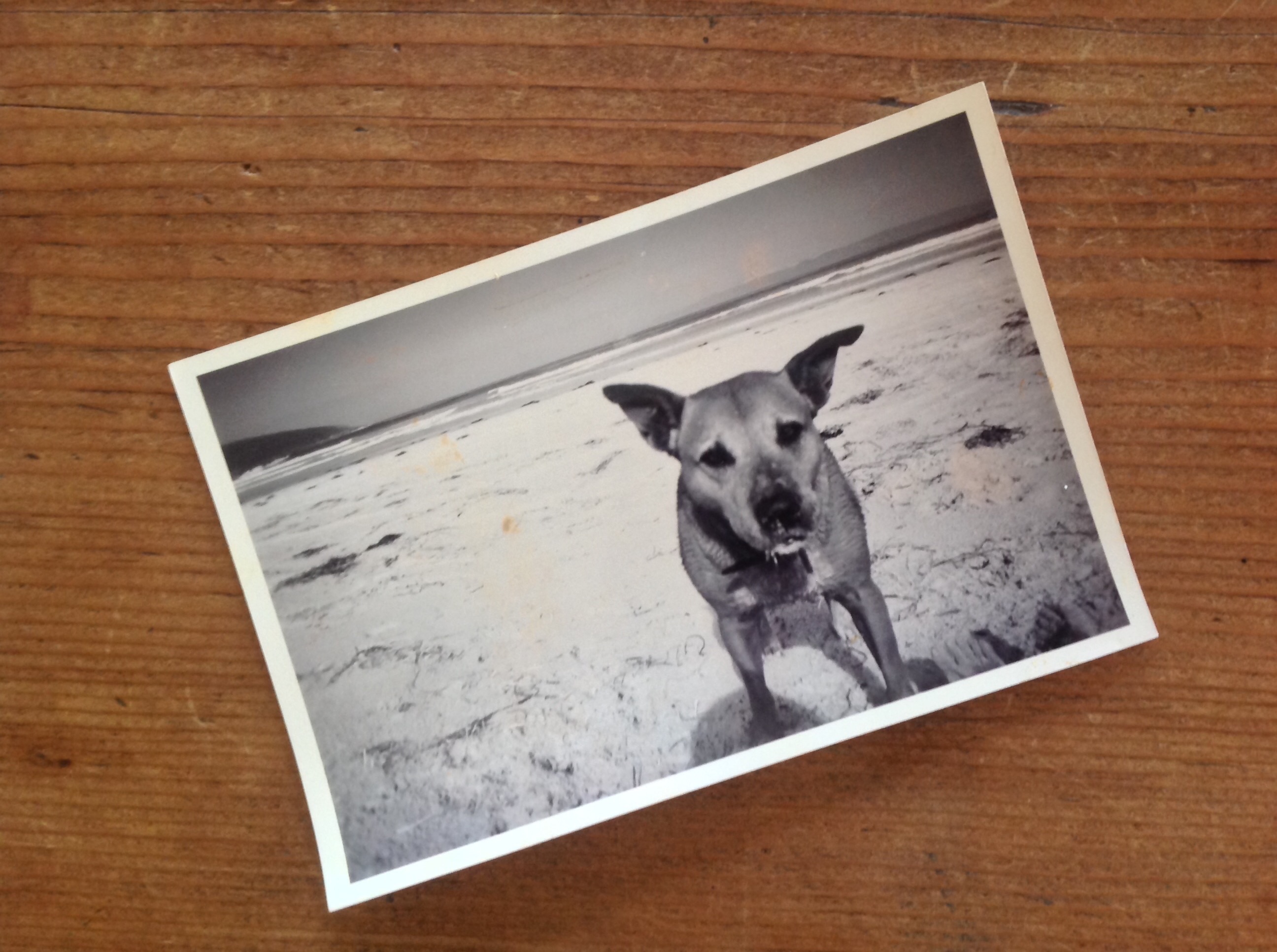
The central character of my last Longform ‘Tim Winton’s An Open Swimmer and the art prize that got away’ (now on ABC Open) was a dog. And my sTory of Sydney and art school would be incomplete without her as my sidekick.
She was a frantic white wash chaser but never a swimmer.
1997 Sydney
I adopted a dog off the wall ads at the local supermarket. I was single and wanted a companion and from my list – ferret at the top (rejected by flatmates) I settled on dog. Not sure where ‘ soulmate’ was. I was 26 and not ready for a cat (re Kitty FLannigan gag about being past it). THe dog was a runaway that had been rescued but her rescuers couldn’t keep her.
the dog, whom became Sam but NEVER answered to that because it was never her real name, was maybe two years old when I got her. A ridgeback/ red healer/ bull terrier cross. Very pretty, enormous chest and, unknown to me at first- a Fighter. I proceeded to have a very steep learning curve with this marauding runaway of an animal. I honestly did announce to my flatmates one day “I’m taking Sam for a fight…I mean walk”. And if I’m to be totally honest I was also a marauding runaway of a human at the time.
In 1997 I lived on Australia Street in a terrace in Newtown and SAm began to have arch enemies everywhere. Most notably 1 black and White female border collie whom she could sense at 500m on the other side of Camperdown Park. She’d bolt and I’d be bolting after her across the park to then wrestle her off this particular b&w border collie. I got pretty good at stopping dog fights and i mean she REALLY liked to fight.
She terrified one of my flatmates (a cat person) but seeing as he had the only car I always needed his help to get her back when she ran off to King Street in Newtown shifting food scraps.
In 1998 when I started at The National Art School I got her a yard by moving to a house marked for demolition in Leichhardt. SHe ran off there as well but this one time the bouncer for the brothel on Parramatta rd tried to catch her and pulled off her collar. He called me and we chatted leaning on the velvet curtained windows outside the brothel. He said he only grabbed her because she was a girl but where he grew up they bred that kind of dog to fight professionally. Adding that he would never have gone near a male version of her and what a mighty fine looking dog she was. Let’s just say this was a light bulb moment. EVentually she wandered home.
I took to only walking her in enclosed spaces like the local velodrome. But She didn’t like skateboarders either, upending one mid flight by grabbing the skateboard with her teeth as he went past, sending him flying, and me and his mate into hysterics, with me also profusely apologising.
I loved her and her many faults, she really liked people and no ones perfect. WHen she lept off a small cliff in sheer excitement at seeing water for the first time and needed a knee reconstruction I was distraught. The cliff was at the back of the old asylum in Balmain that has since been converted into an art school.
So after not winning the art prize I concocted the idea of getting fellow NAS students to donate stuff that I could sell. I made up a flyer and distributed it. BUt, alas, for my phrasing of the ‘dog and cliff ‘ story and it being art school an all, everyone thought it was a poem and i was being all ‘bohemian arty’. SIGH.
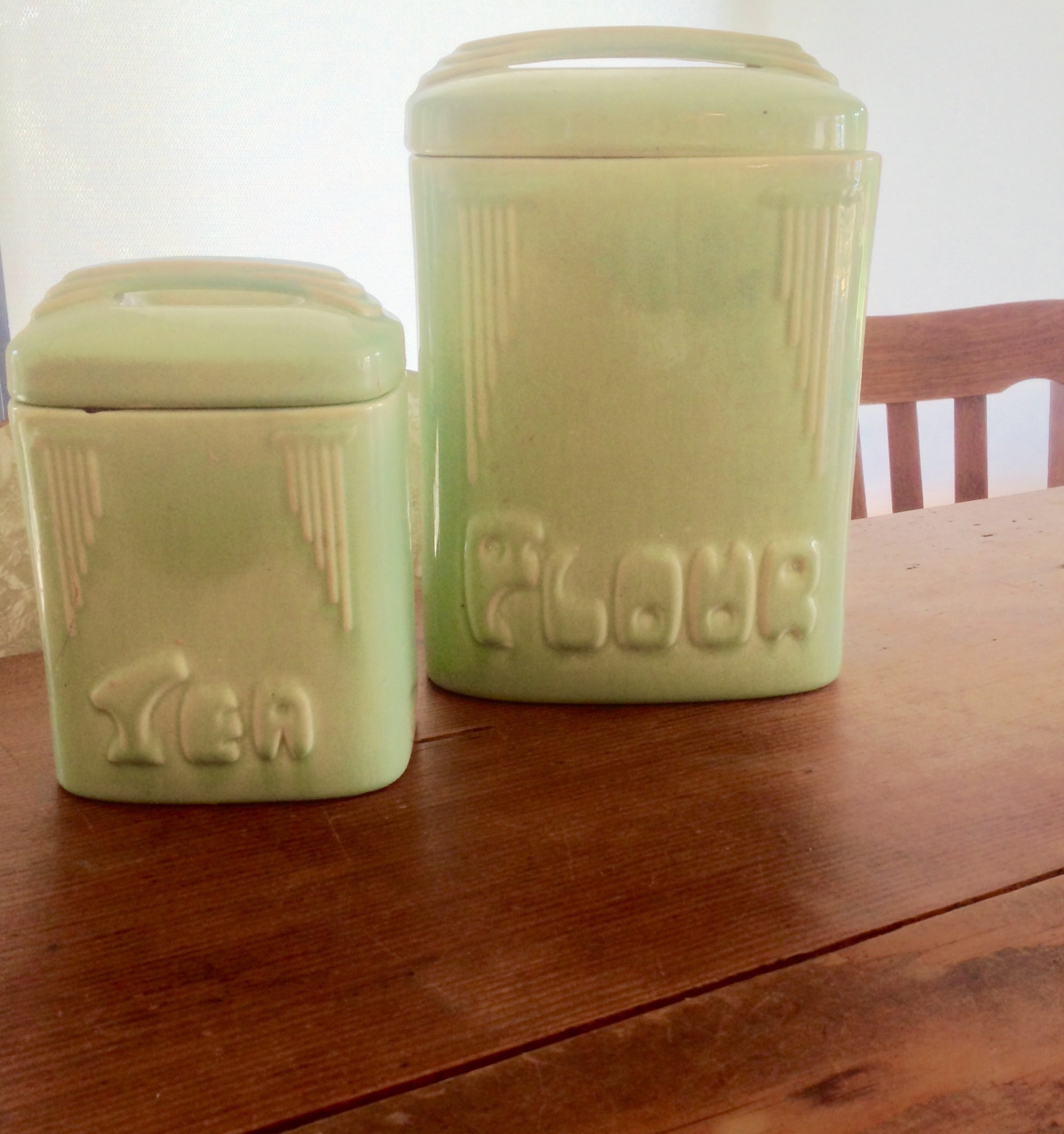
Eventually after correcting everyone and killing off the idea of me as a performance artist i did get some stuff and she was repaired. These Bakewell Brothers cannisters were also damaged and beautiful so I kept them from the garage sale donations.They date from the 1920’s and are called Beulah Ware.
These were rejected by the Powerhouse Museum due to cracks.
You can take a girl out of a museum but you can’t kill off the eye for good old stuff! My friend said that was okay for me to keep them as they are fragile. This friend was a fair bit older than me, had grown up in inner city Sydney in the 50’s and at one stage been subjected to electroshock therapy in the above mentioned asylum bexcuse she had bipolar. She had been given many interpretations of her brain by the time I met her.
WHen we moved to the open spaces of Perth in 2001/2 and SAM met the beach she rarely fought again. Just the odd b&w border collie. I always put it down to the pressures of inner city life. And those border collies were all brains to her brawn. She passed away in Margaret River. We now have a brown and white female border collie. She soooo wouldn’t be okay with that.
NO ONE OR NO DOG WAS EVER INJURED DUE TO THE FIGHTING IN THIS STORY. ONLY SHOULDER LIGAMENTS WERE DAMAGED, repeatedly.



 Tarhairedjack toons and draws
